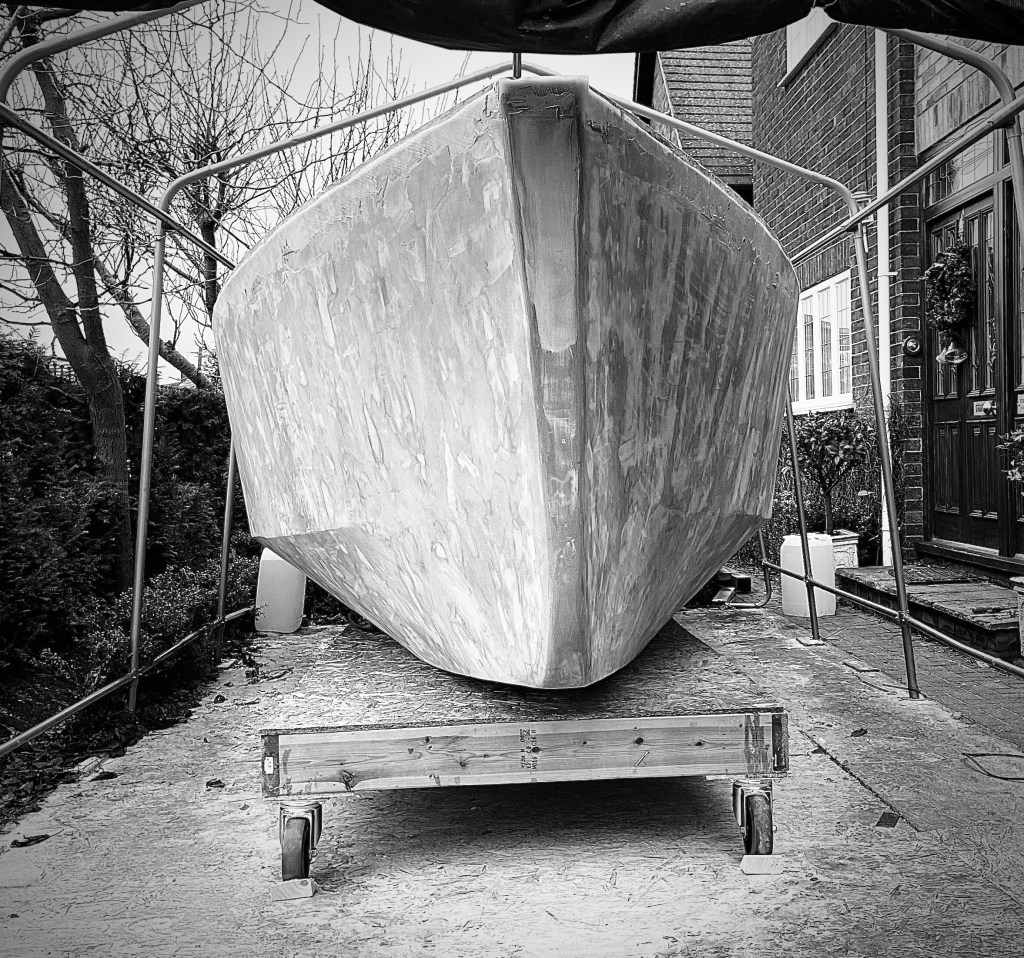
Bit of a long update but we have had a couple of big days and reached a major milestone. We turned Hull 43 over, and have a hull right side up on the drive. Fantastic culmination of the hull construction phase. I have added a bit of detail of what we used in case it is useful for other builders.
Although there will always be fairing to do, it’s basically a law of nature, we took the opportunity of a weather window and a free day to bite the bullet and get her turned. In the end getting through the whole process took us two full days, with four of us working together for much of that.
Essentially we had a number of things to do;
- Prepare the boat to be turned
- Open up the tent fully
- Build a scaffold and rig the lifting gear
- Remove the jig (test of faith)
- Turn the boat
- Re-purpose the jig bed
- Drop the scaffold
- Put the tent back together
This was all too much to complete in one day.
It was also the point of bringing together a series of decisions about how we were actually going to get the turning done. I guess all builders will take different decisions depending on their experience, access to equipment and location of where they are building. Our plans came together into a practical solution, that worked……but I wouldn’t claim elegance.
Preparing the boat was about deciding how attach lifting gear to her, as there aren’t really any obvious and robust lifting points. We decided to use some 2’ by 4’ timber planks and ratchet straps as our starting point. We placed the two planks, across the boat where we thought the best points of balance would be. One behind Frame A and one in front of frame D1, in actual fact we should probably have gone for in front of frame D.
Each plank was cut to overhang the hull side by about 6 inches or so. We drilled each end and inserted an M10, 100mm long shank Eye bolt and eye nut. We then looped a ratchet strap over the hull, around the ends of the planks and back. The ratchet them up…..tight. The original idea was to loop the lifting strops we were going to use through the eyes of the eye bolts, which would swivel in their holes. However in the end we just looped the strops around the planks and used the eye bolts as a stopper to prevent the strops coming off the plank. The two ratchet straps we used we each rated to hold well over 1 tonne each.
We then dismantled some of the tent where the boat has been living since August. We removed the whole of the canopy and the centre pitch poles to give us access to the centre of the boat.
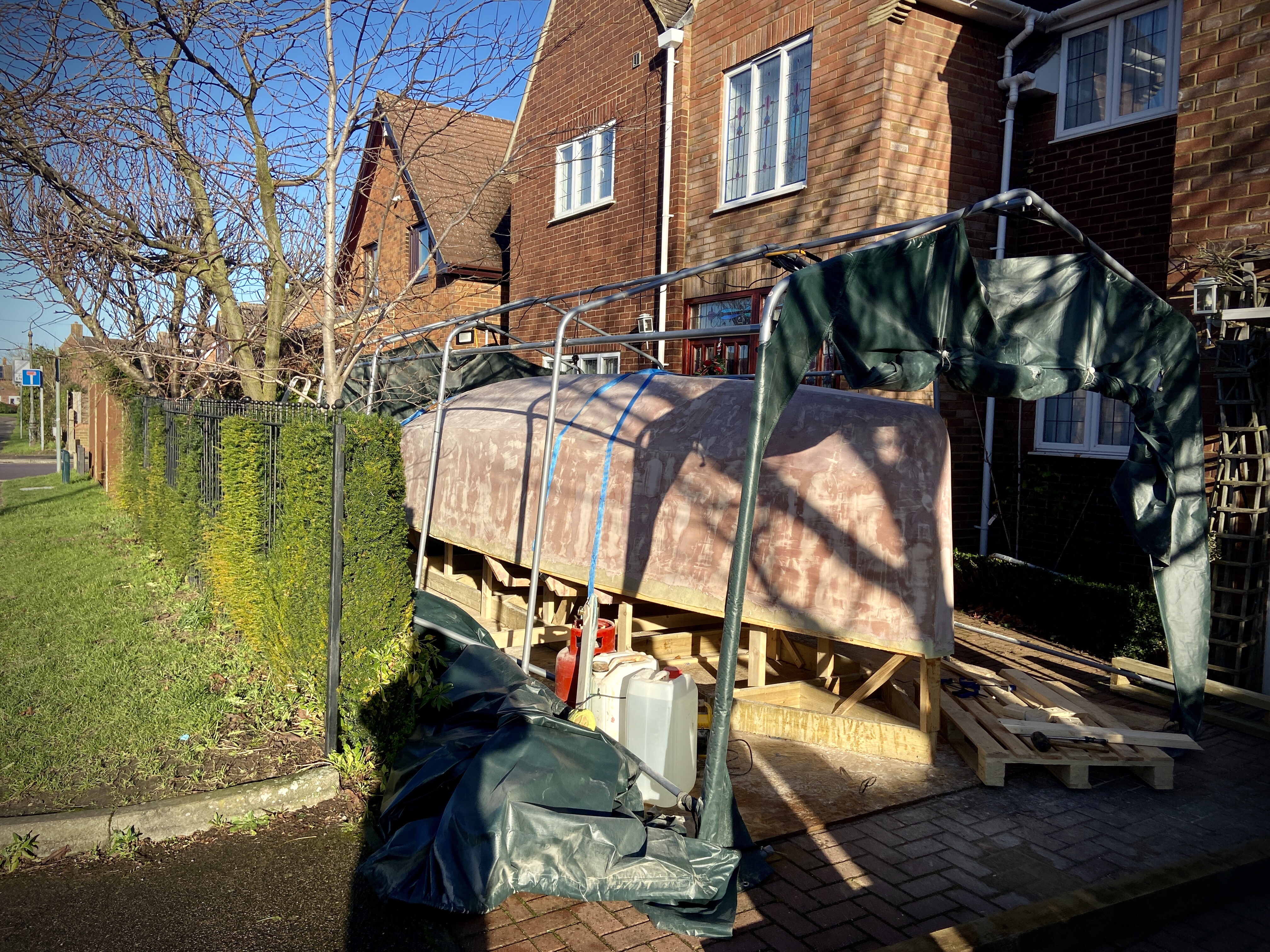
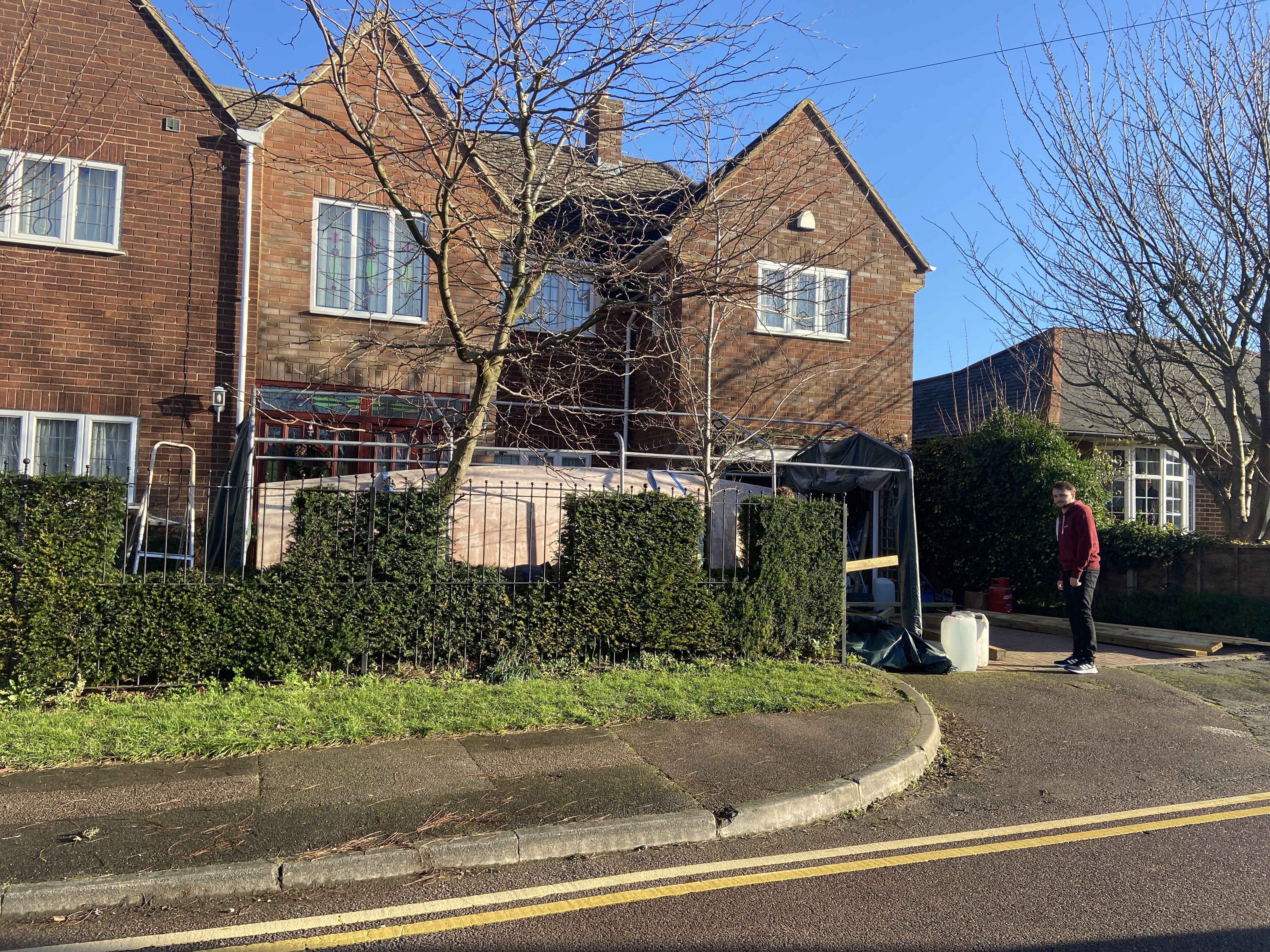
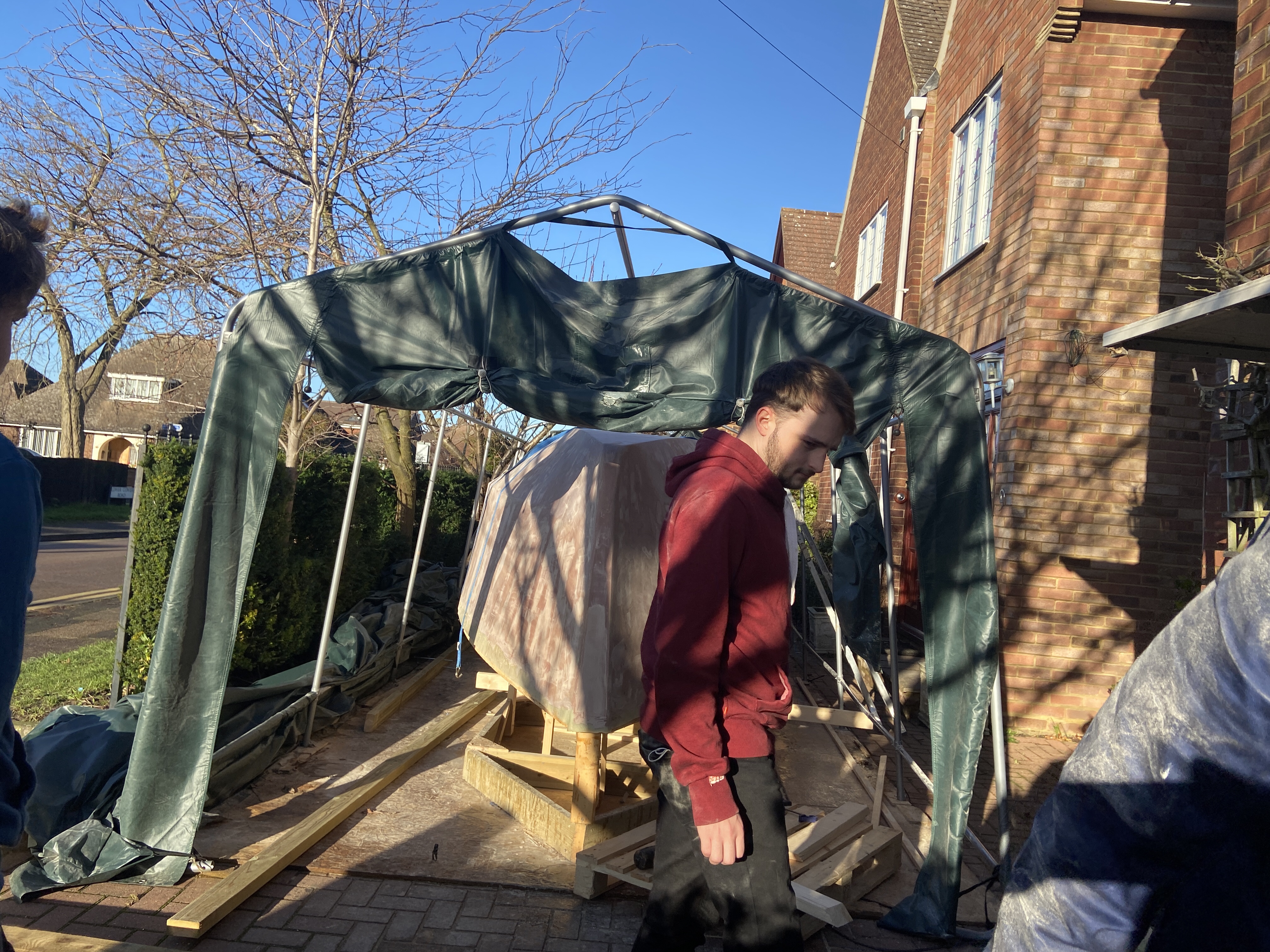
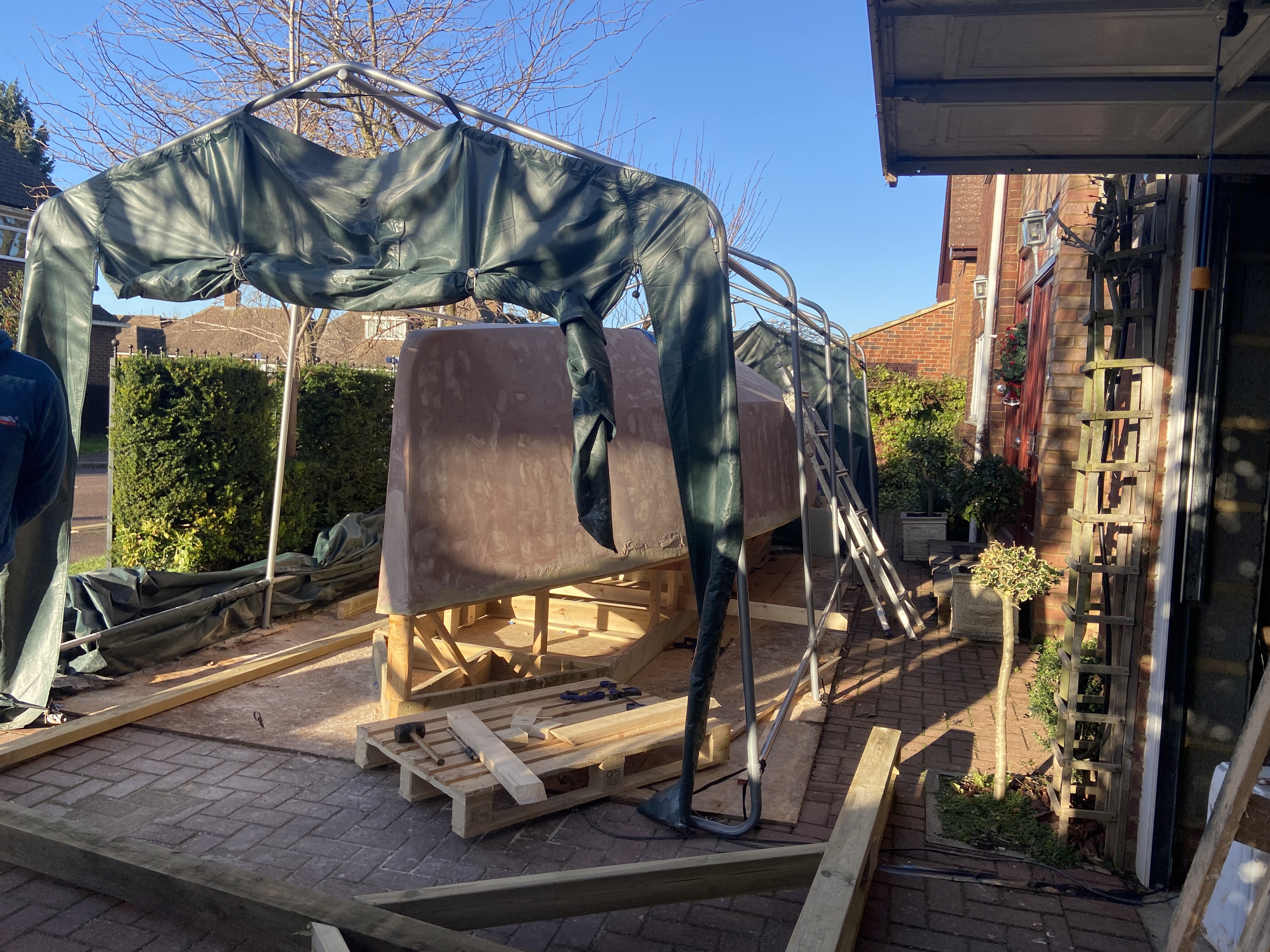
On with the scaffold construction.
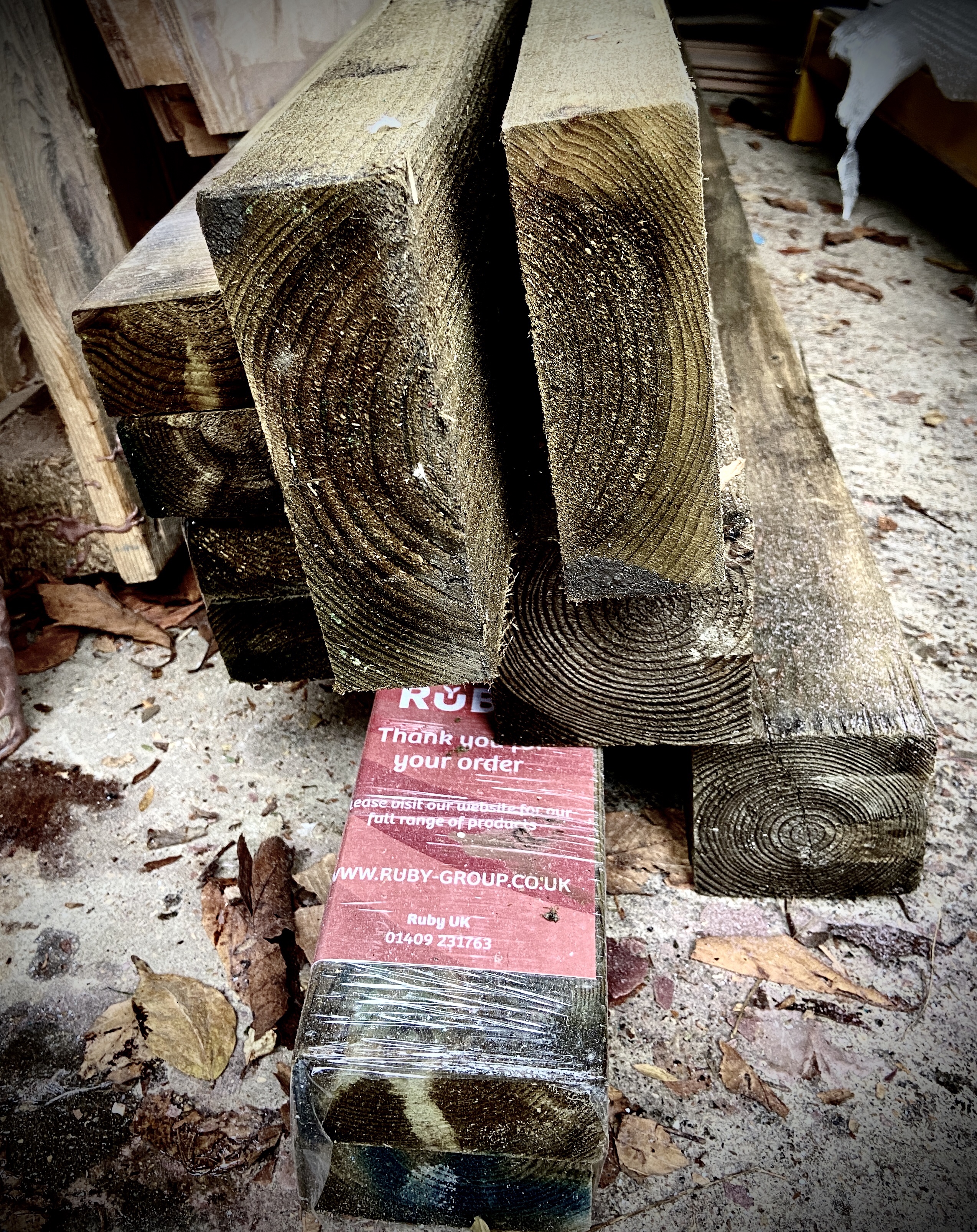
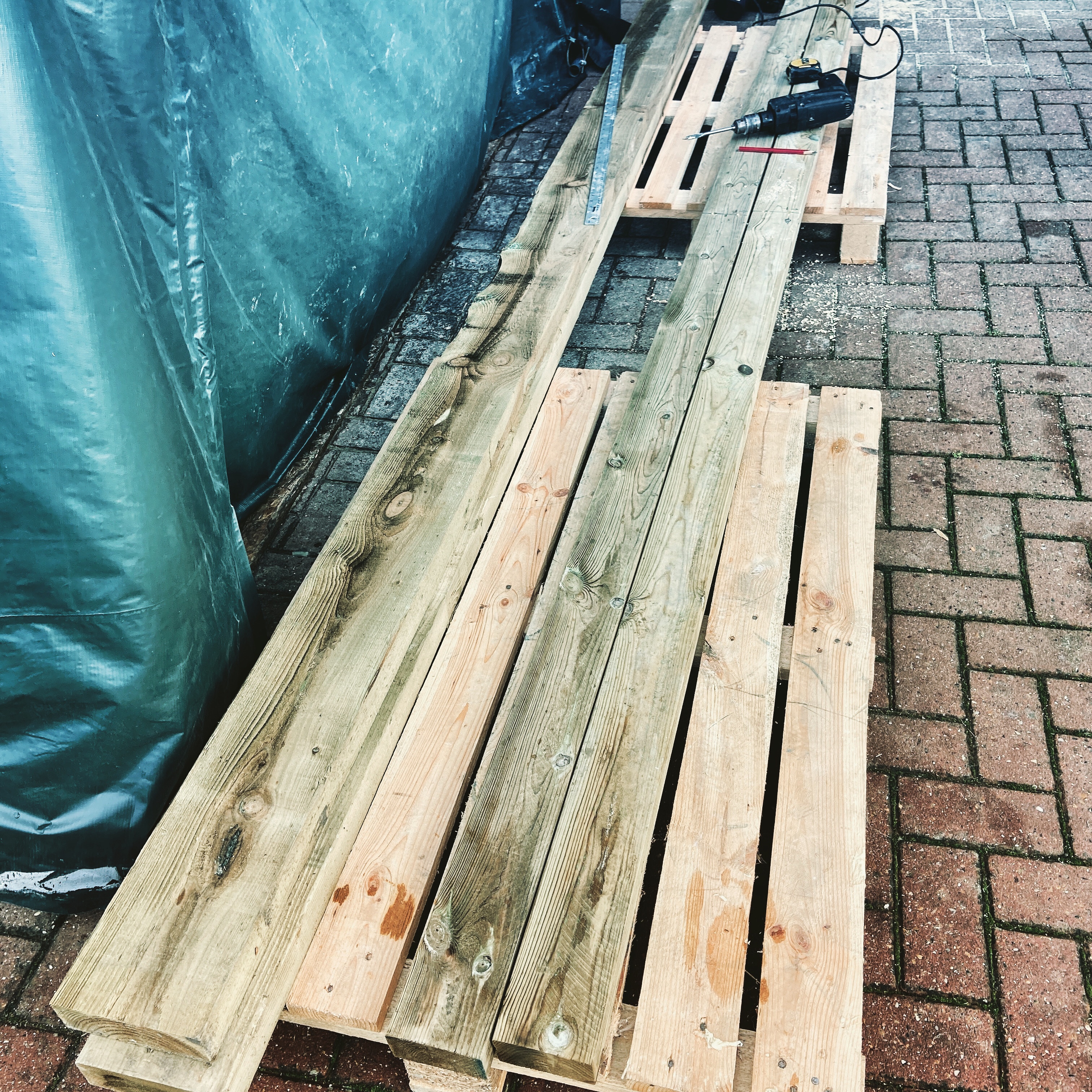
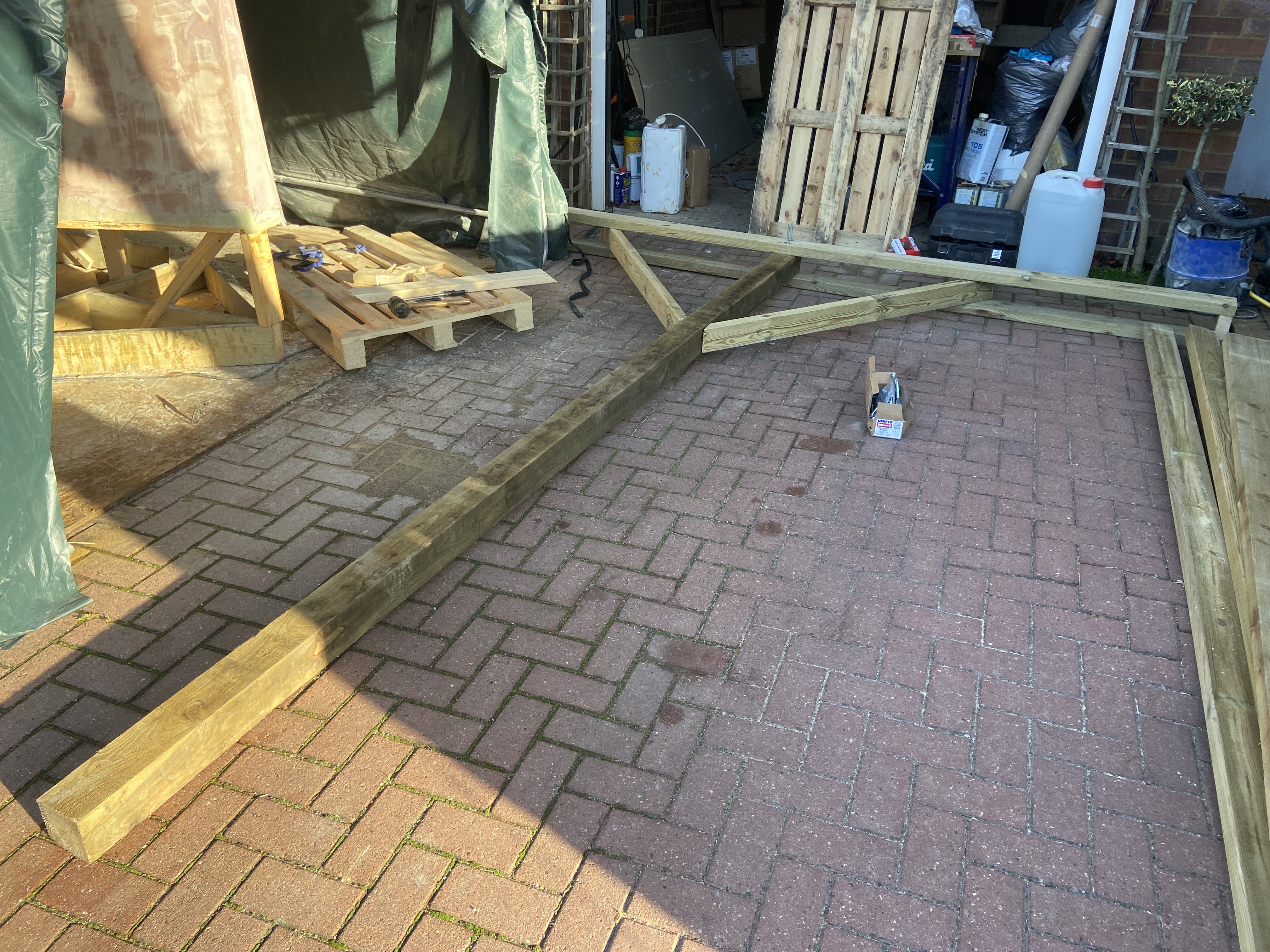
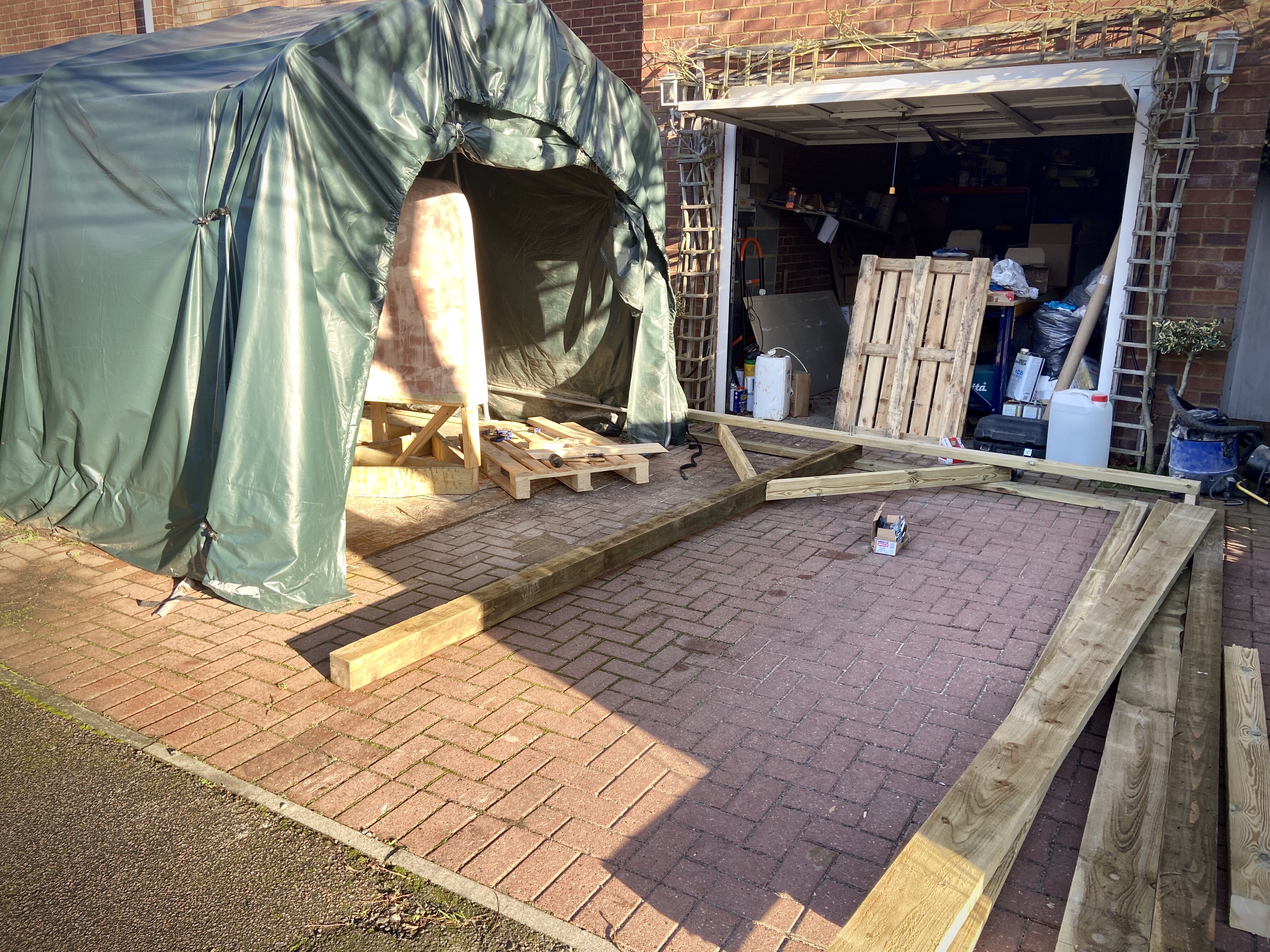
This we built from,
- Two, 3.6m, 4’ by 4’ posts to form the uprights at each side
- Four, 3.6m, 4’ by 2’ planks that we used to create the footings for the uprights, one bolted either side of the posts
- Two, 3.6m, 6’ by 2’ planks that we connected either side of the uprights at at the top, for load bearing over the hull
- Two more 3.6m, 4’ by 2’ planks were cut up and used to form bracing arms at the base of each up rights, and between the uprights and the load bearing beams.
The main points of the scaffold were held together by M10 coach bolts, two at each point.
One upright was constructed on the driveway and lifted into place, whilst the second was constructed within the frame of the tent, having pre-drilled the holes for the coach bolts. Lifting and bolting on the load bearing timber beams was interesting at 3.6m above the ground. The boat hull was a convenient platform to stand on. There was an ongoing discussion with the Mrs about whether protecting the house windows or the boat hull was a higher priority if we dropped anything.

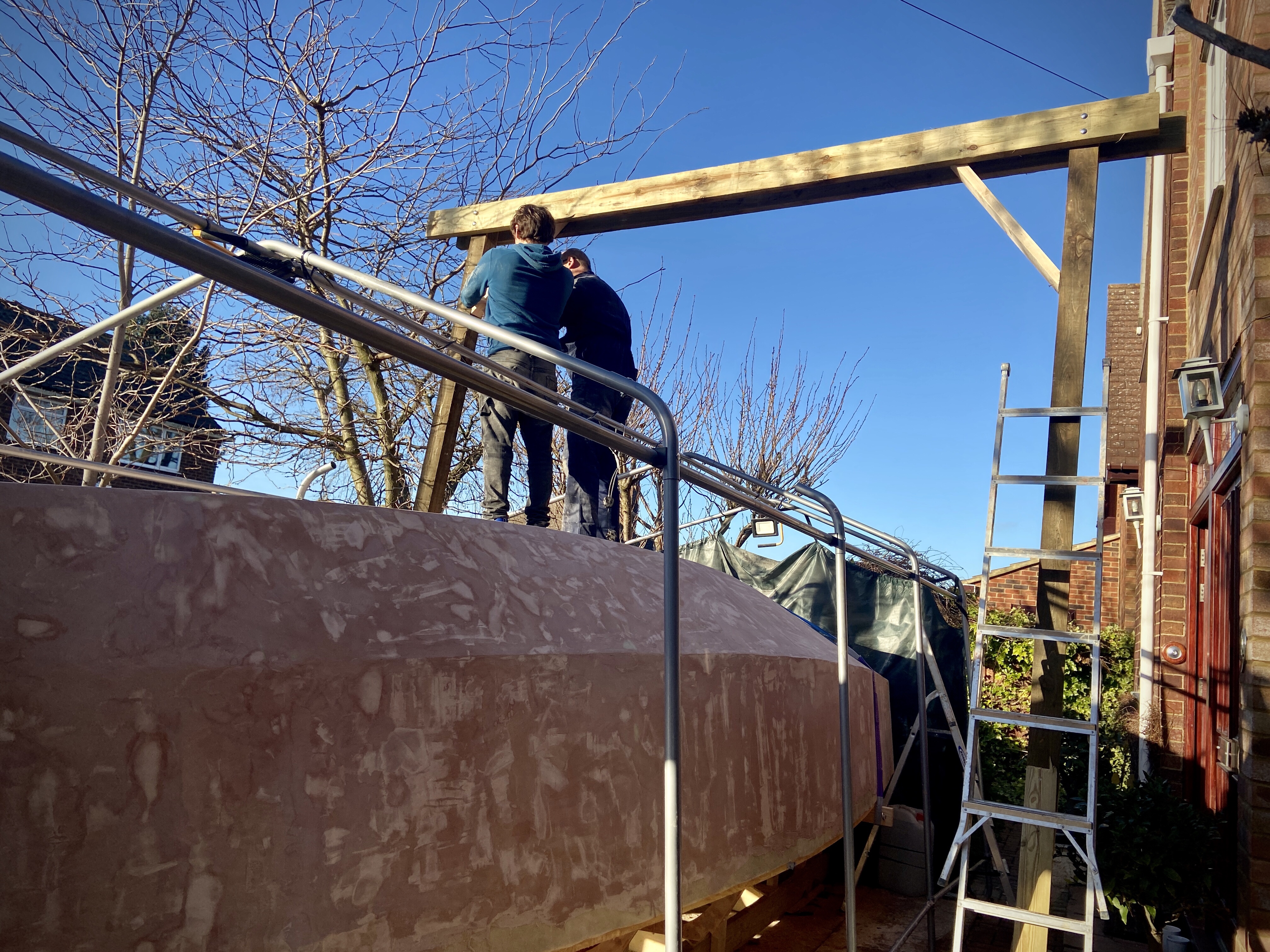
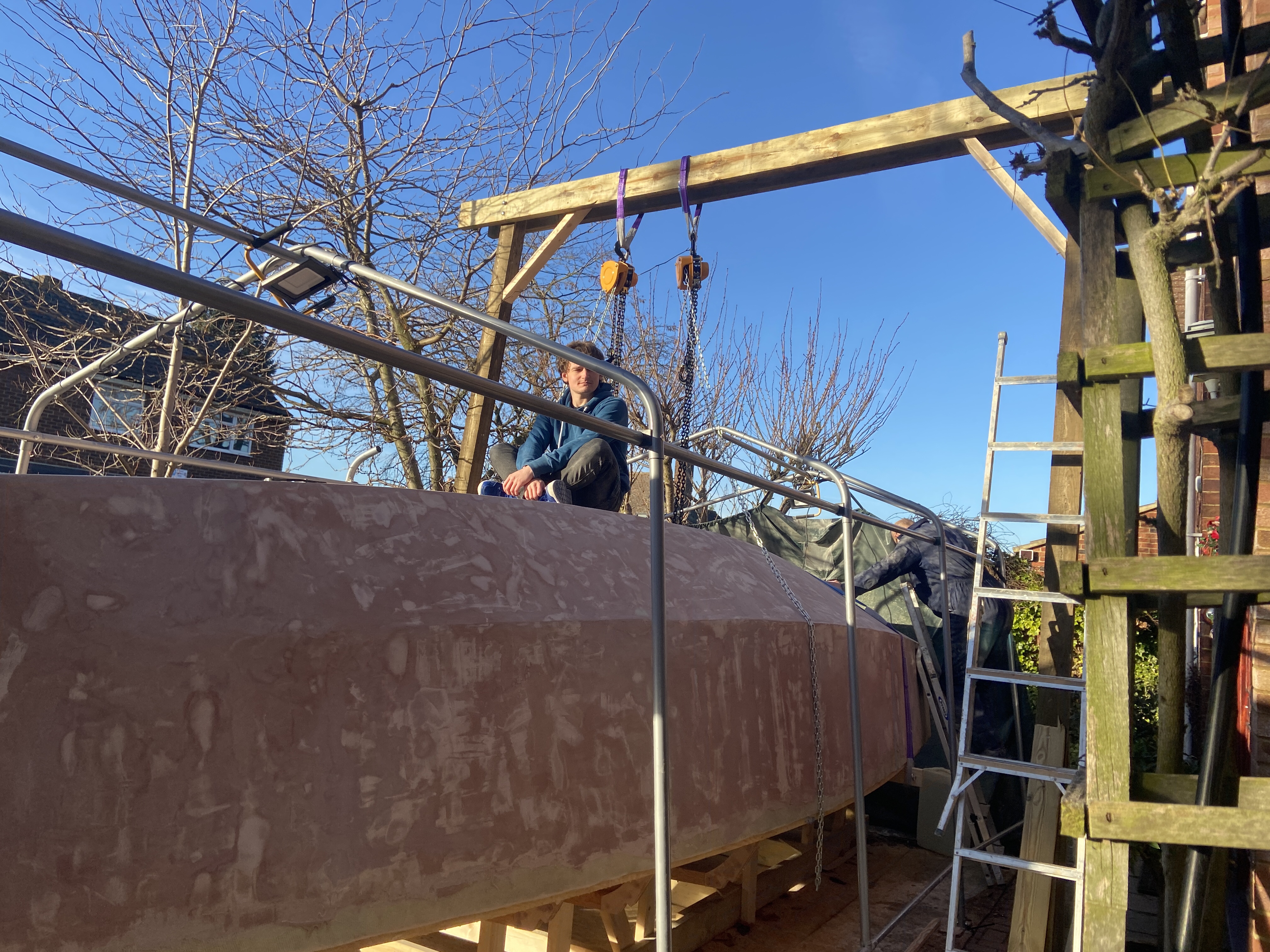


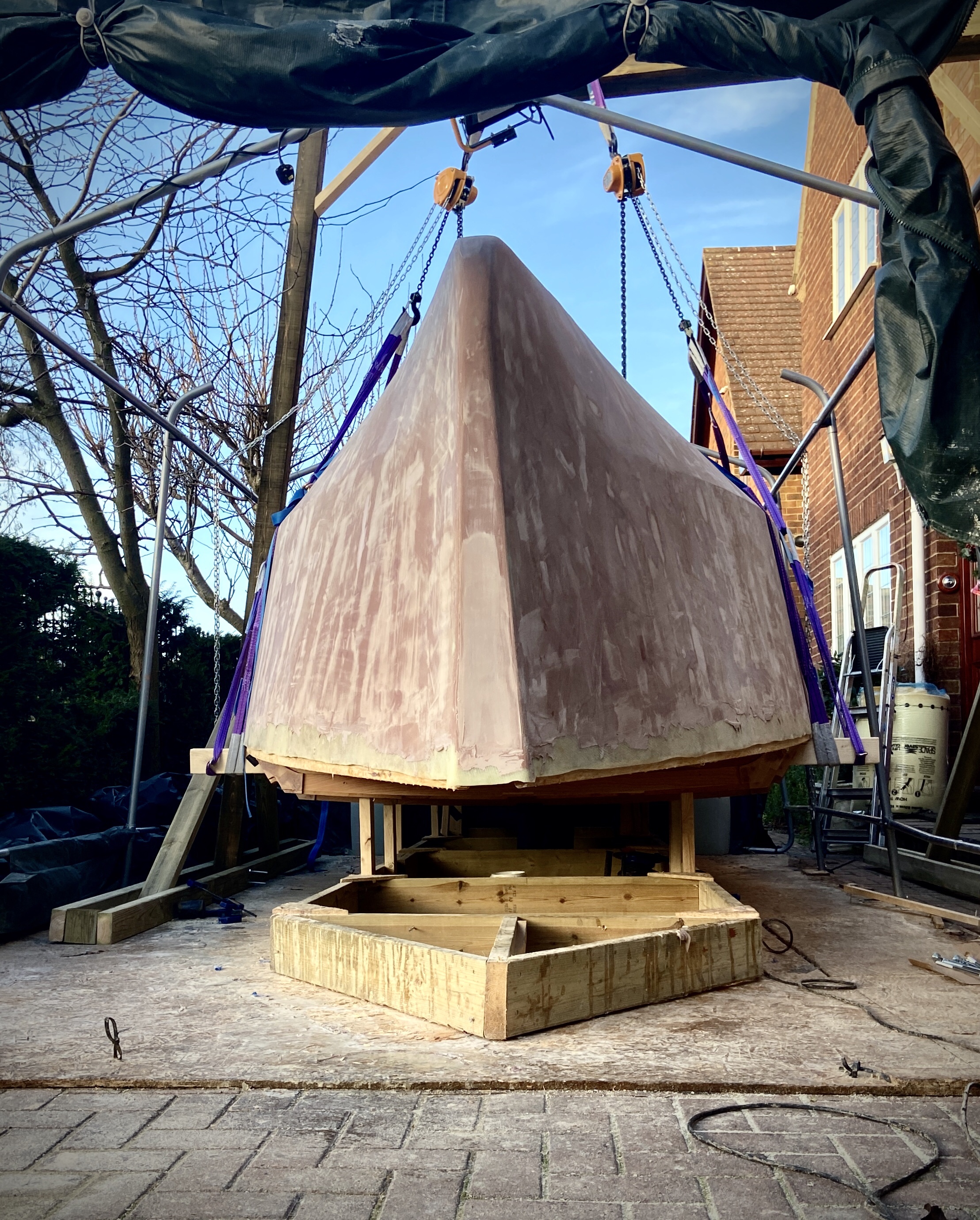
We hung two chain blocks off the load bearing beams using a 1m lifting strop for each. All the strops and chain blocks we used were rated at 1 tonne. Both blocks were placed somewhere near the centre of the beams. We connected the chain blocks to each of the planks we had ratcheted to the hull with 2m long, 1 tonne lifting strops. Each chain block controlling a side of the hull via two lifting strops.
Then came the confidence check. Would the scaffold take the weight. We decided to tension her up a bit by taking up the strain gently, but before we knew it we had lifted the boat and it’s jig completely off the ground! Oops. But at least it worked.
Then the next confidence test. Removing the jig. It was almost with mixed emotions I set about dismantling the jig that we had lovingly built, and which has held our boat safely since the summer. But needs must. As I removed the last screw she rocked free, and gently swayed to the side, she’s as ready to move on as we are I guess.
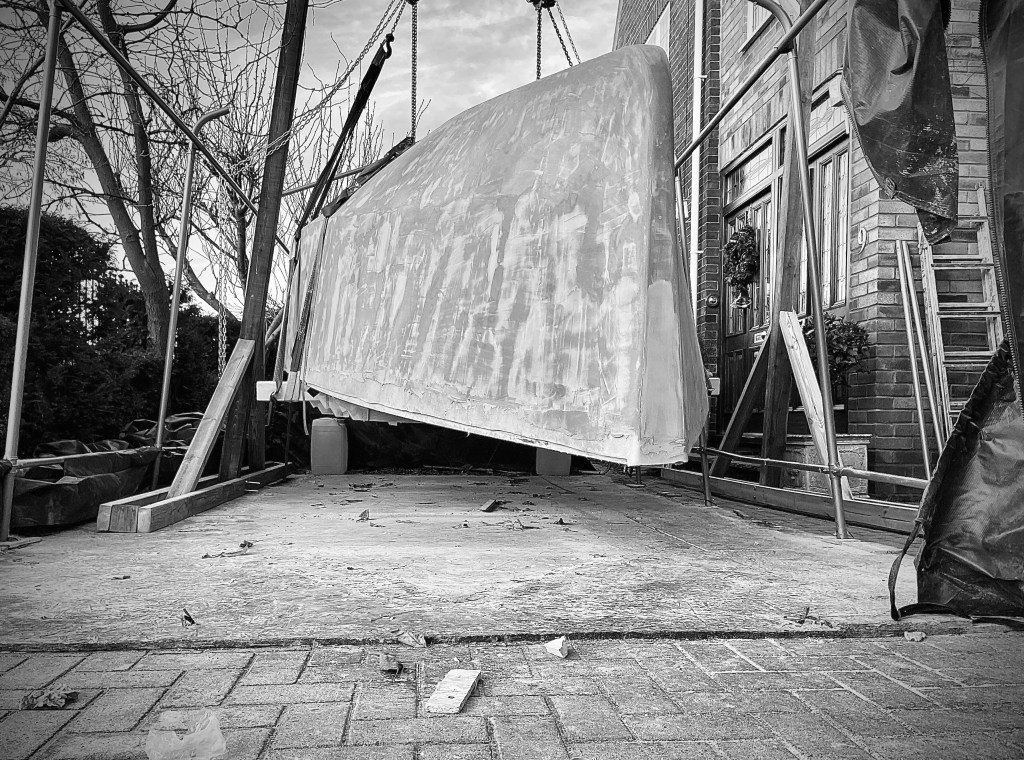
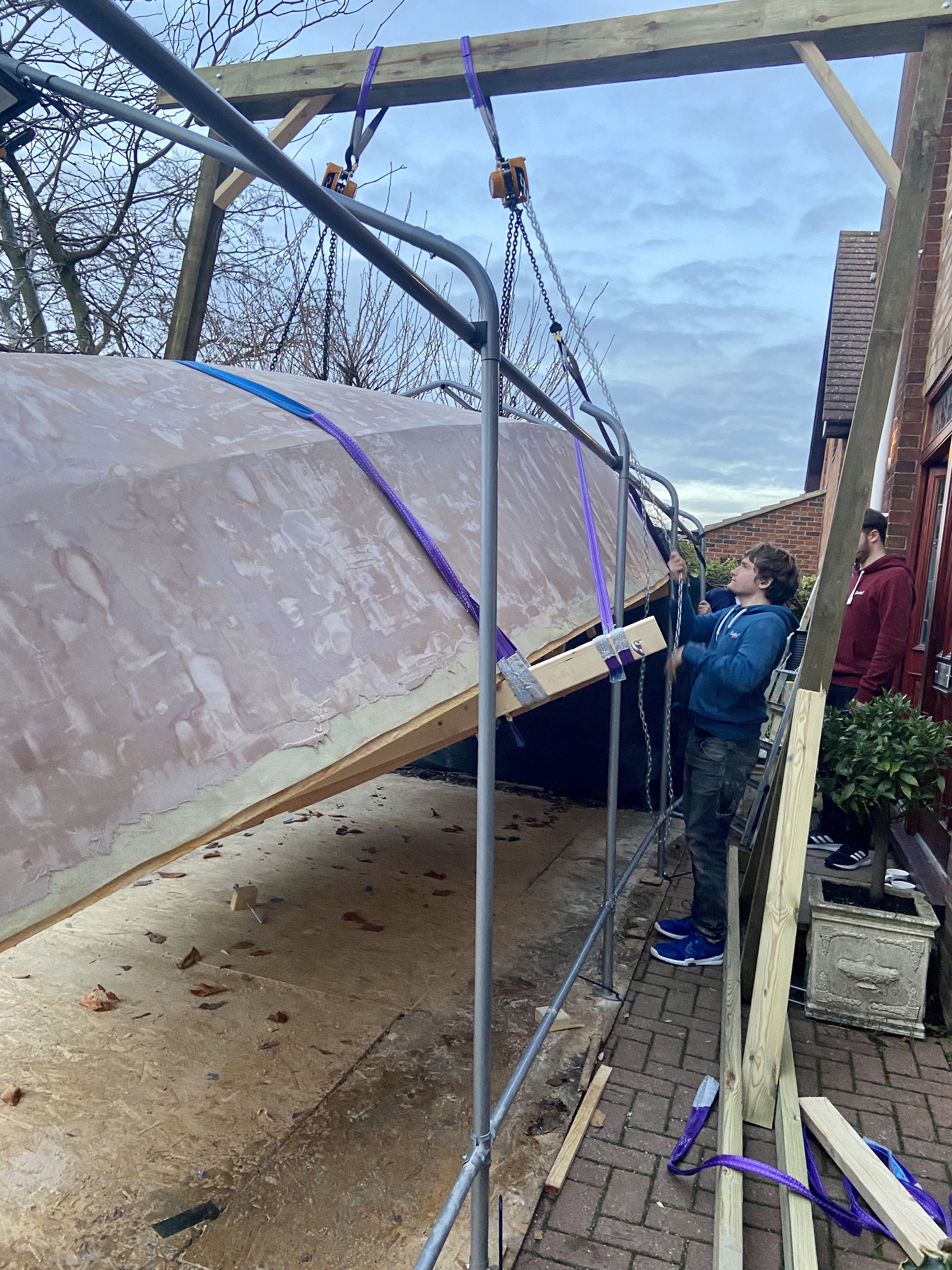
The plan was simple, raise one side as high as possible, whilst lowering the other side until the boat was effectively hanging on her side from the chain blocks. All was going well, until the chain block reached its maximum height, but the planks we had ratcheted to the hull were still dragging on the floor to one side. She wasn’t going to swing free freely. However with the majority of the weight taken up we could manhandle her through the last bit with a couple of us lifting and a couple more pulling on strops we attached to the bottom ratchet planks. A couple of grunts and groans, and pleads of “go for it, pull” and she was through.
But then the lifting gear is connected to the wrong side of the boat to complete the lift, and bring her right side up. So we landed her on her side. Removed the lower lifting strops, and brought them under boat and back over the hull to the same chain block. Then by coordinating lowering and raising accordingly she was upright. We had an upside, right side up boat!!
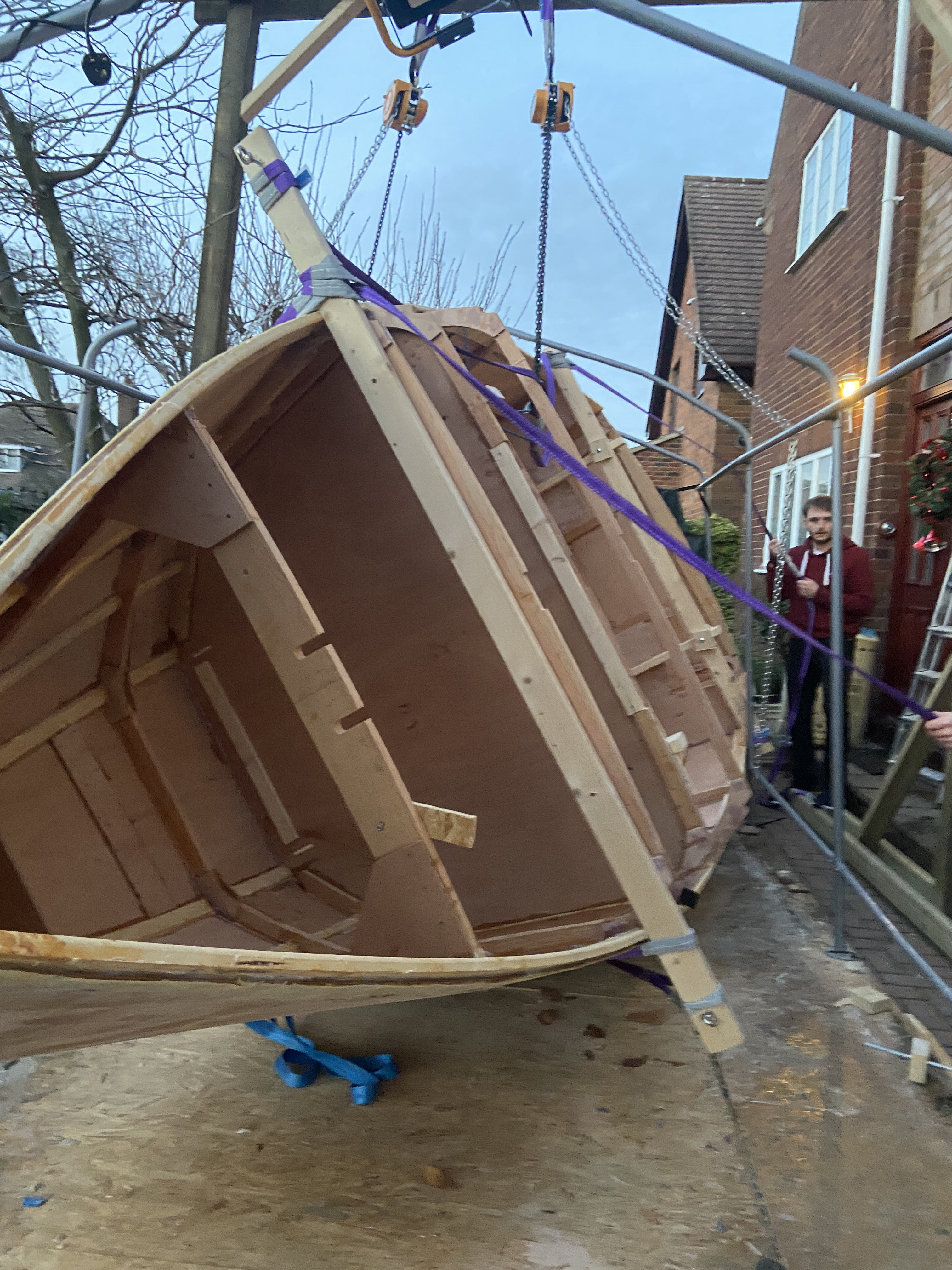
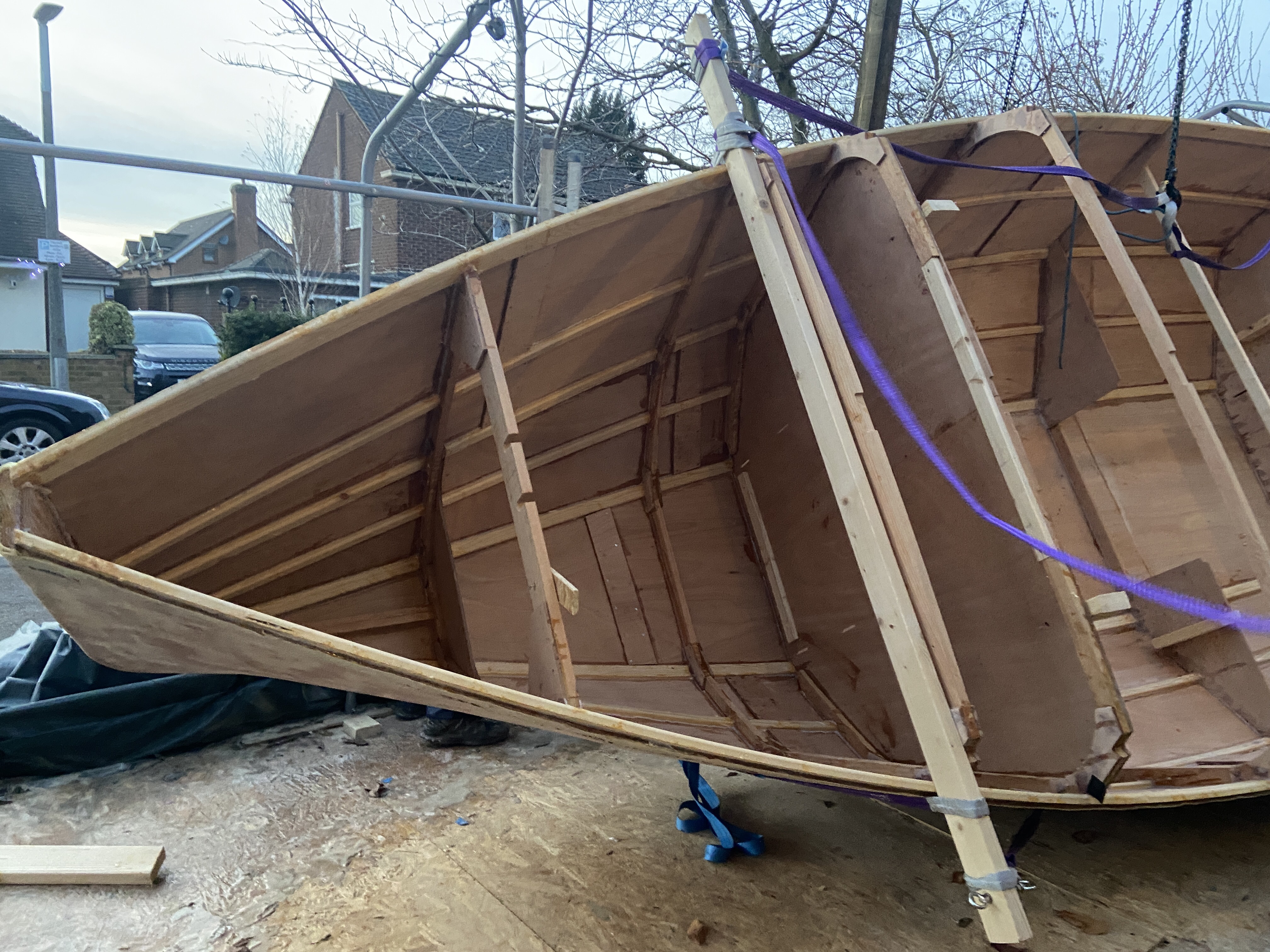
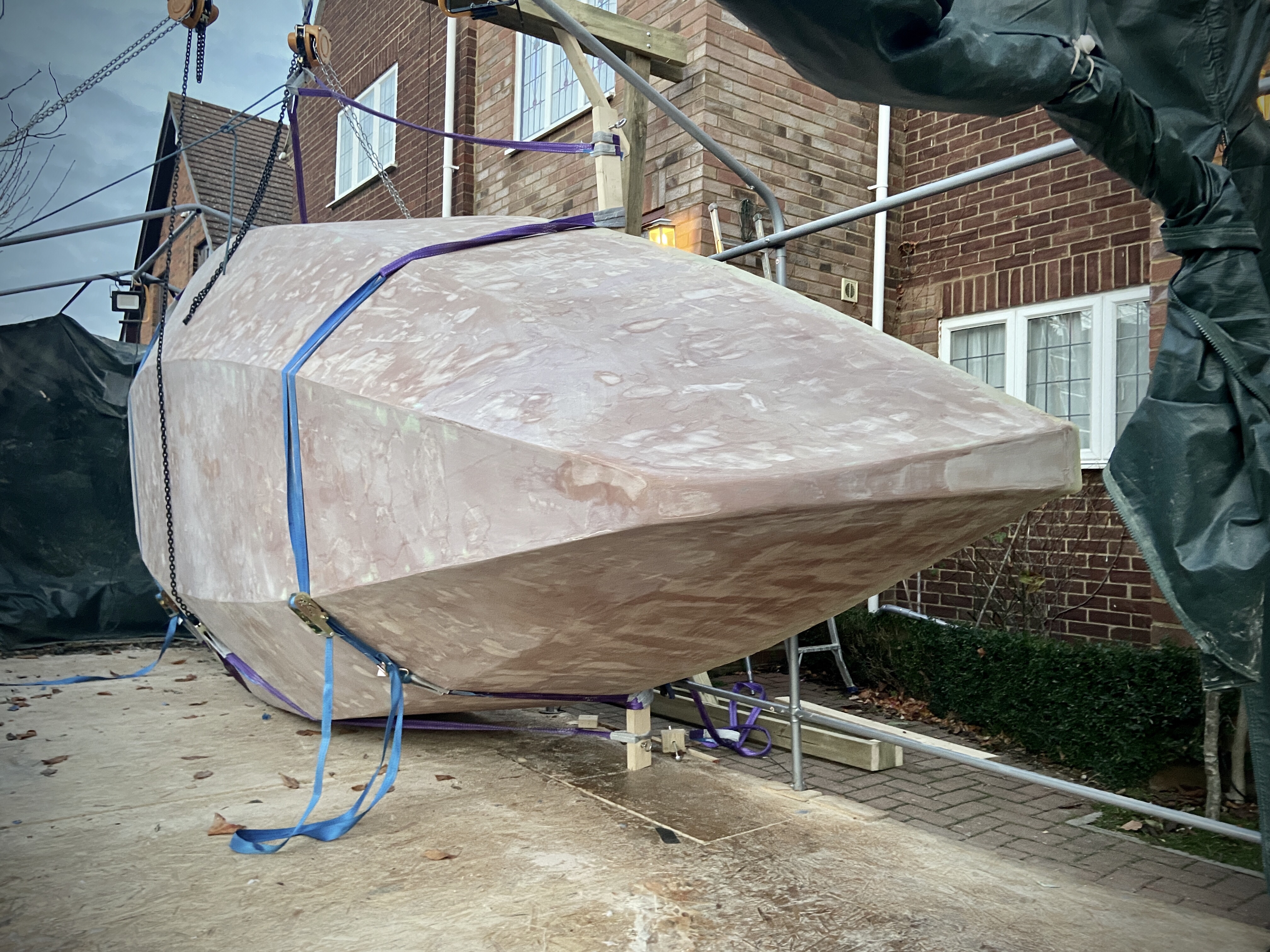
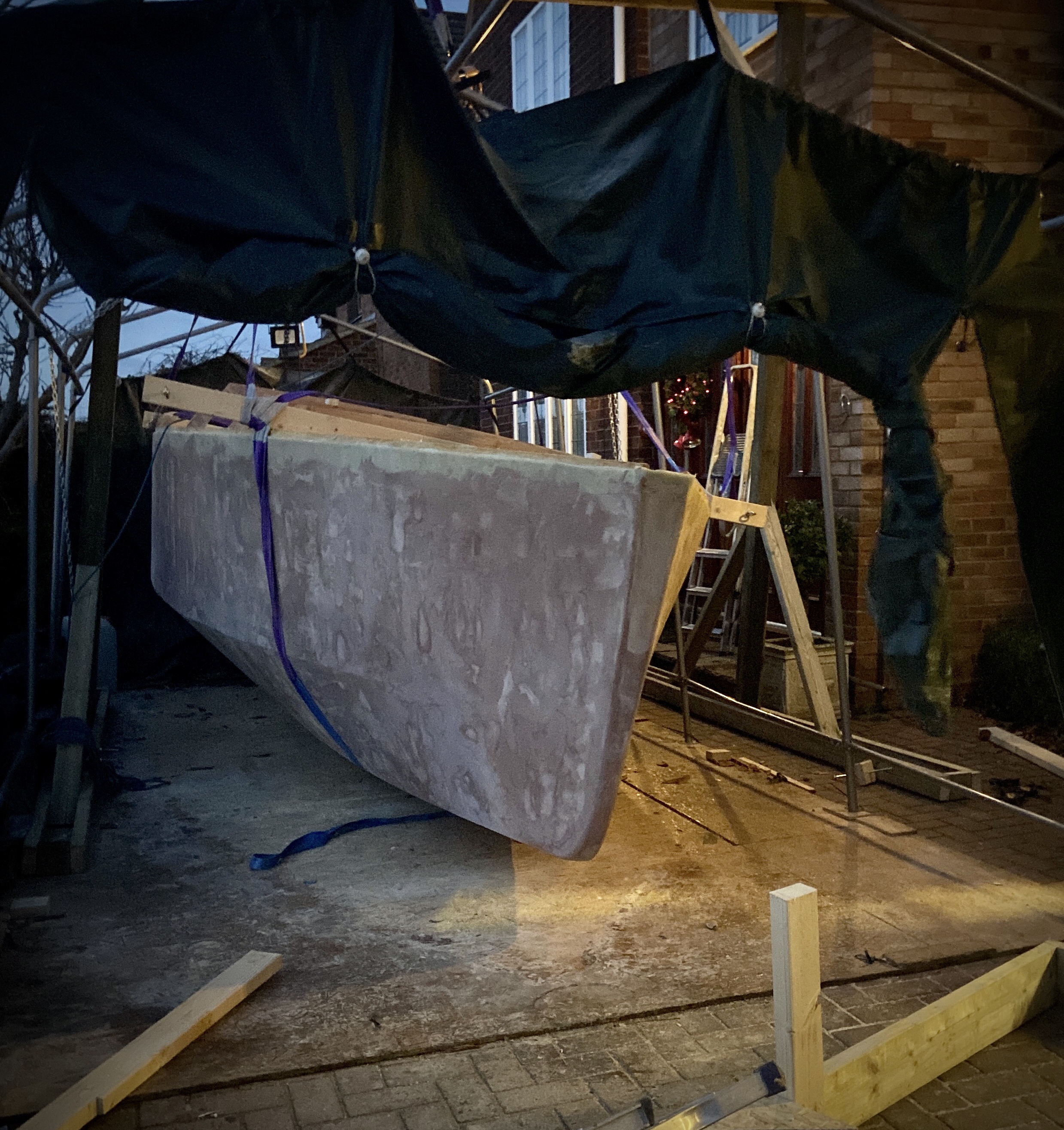
We then lost the light and decided not to progress on in darkness. So we landed her on the floor of the tent and covered her with the canopy in case it rained overnight. A good day.
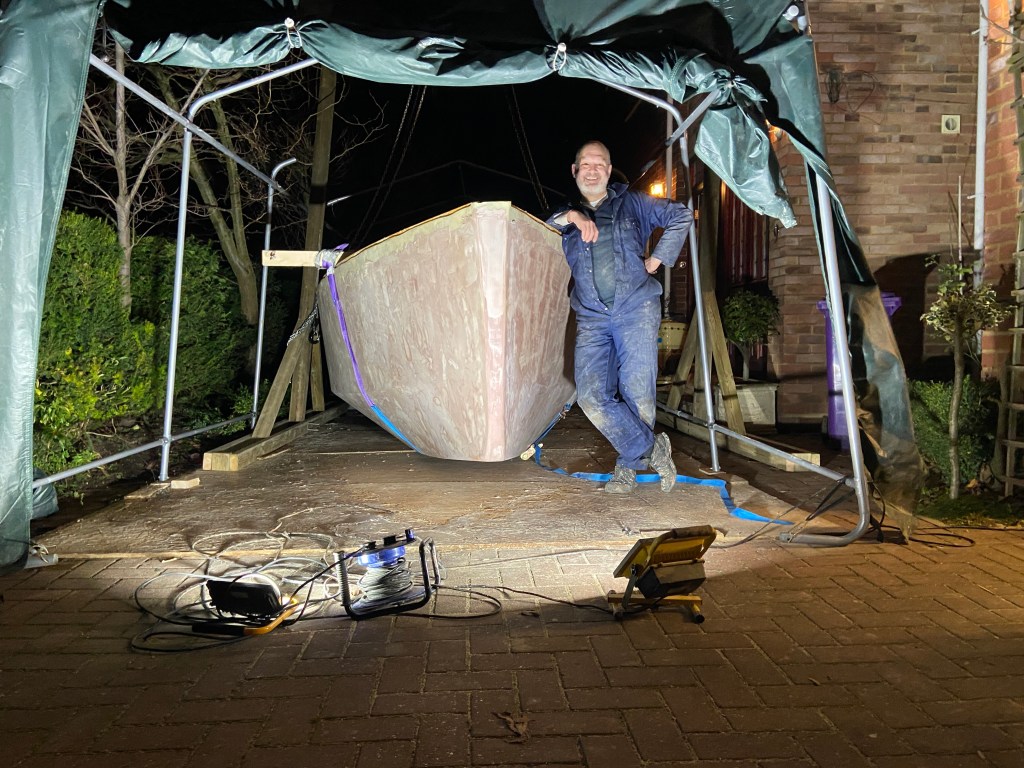
Day 2
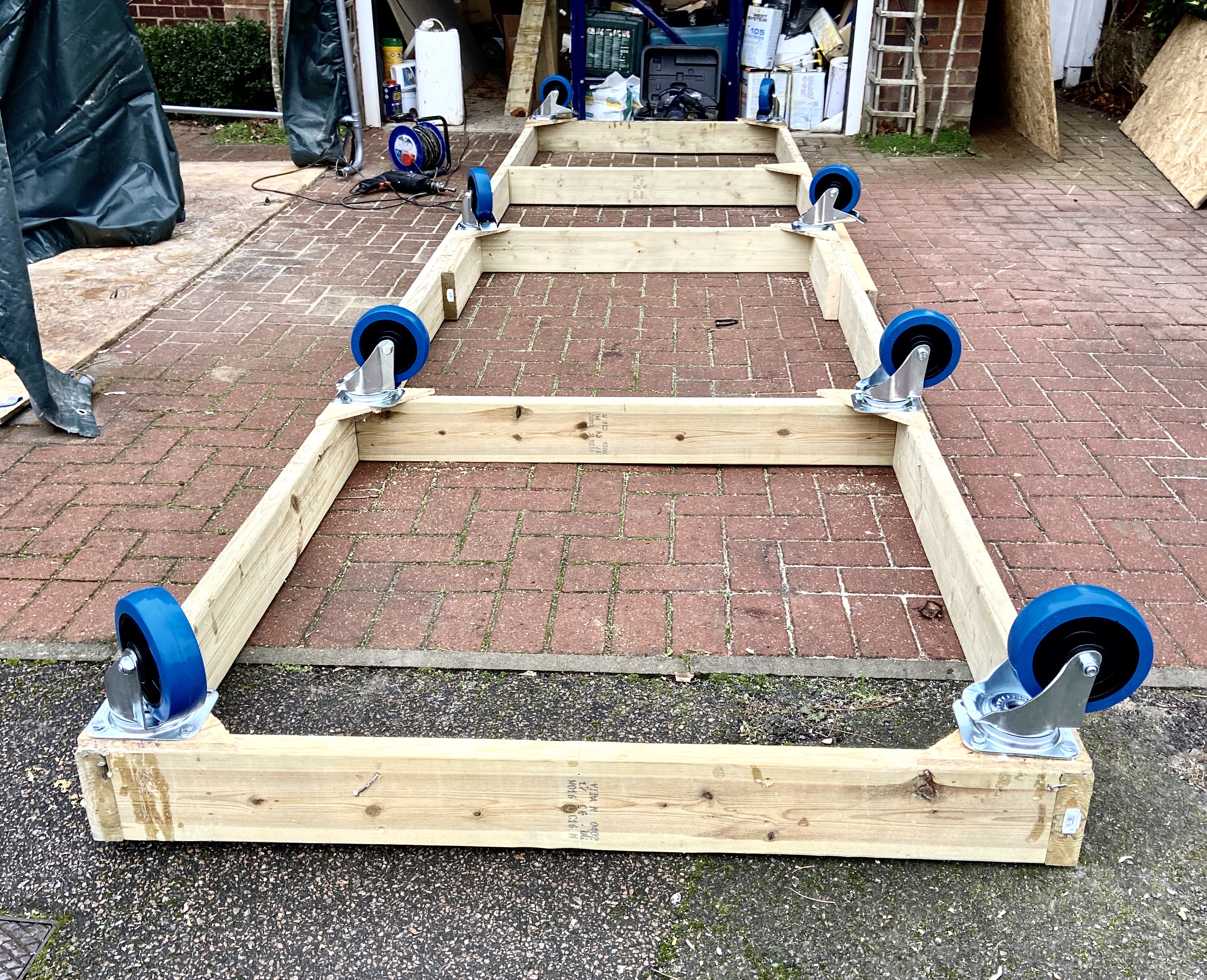
First job on Day 2 was to repurpose the jig. Working in the tent has been fine but it can be tight at times. Also there is more light at one end, unless you open both sides up and you can then turn the tent into a wind tunnel on some days. So we wanted a way of moving the boat around. Also at some point we will need to move the boat off the driveway and I’m not sure it would be an easy crane lift to do….traffic, trees and phone lines.
So the idea was to put the frame that formed the base of the jig on wheels. On went eight, 160mm, rubber wheeled, swivel castors. Each castor is rated to carry 350kg, giving a total load of 2800kg…..should be enough. Wheels on, flipped the jig over and covered the top with some OSB boards to help spread the load.
Under the boat it went and the boat was ready for a road trip! Before finally lowering the boat we placed the boat on blocks and removed the ratchet straps and their planks, replacing these with two 3m long, 1 tonne lifting strops. In case we ever need to lift the boat again.
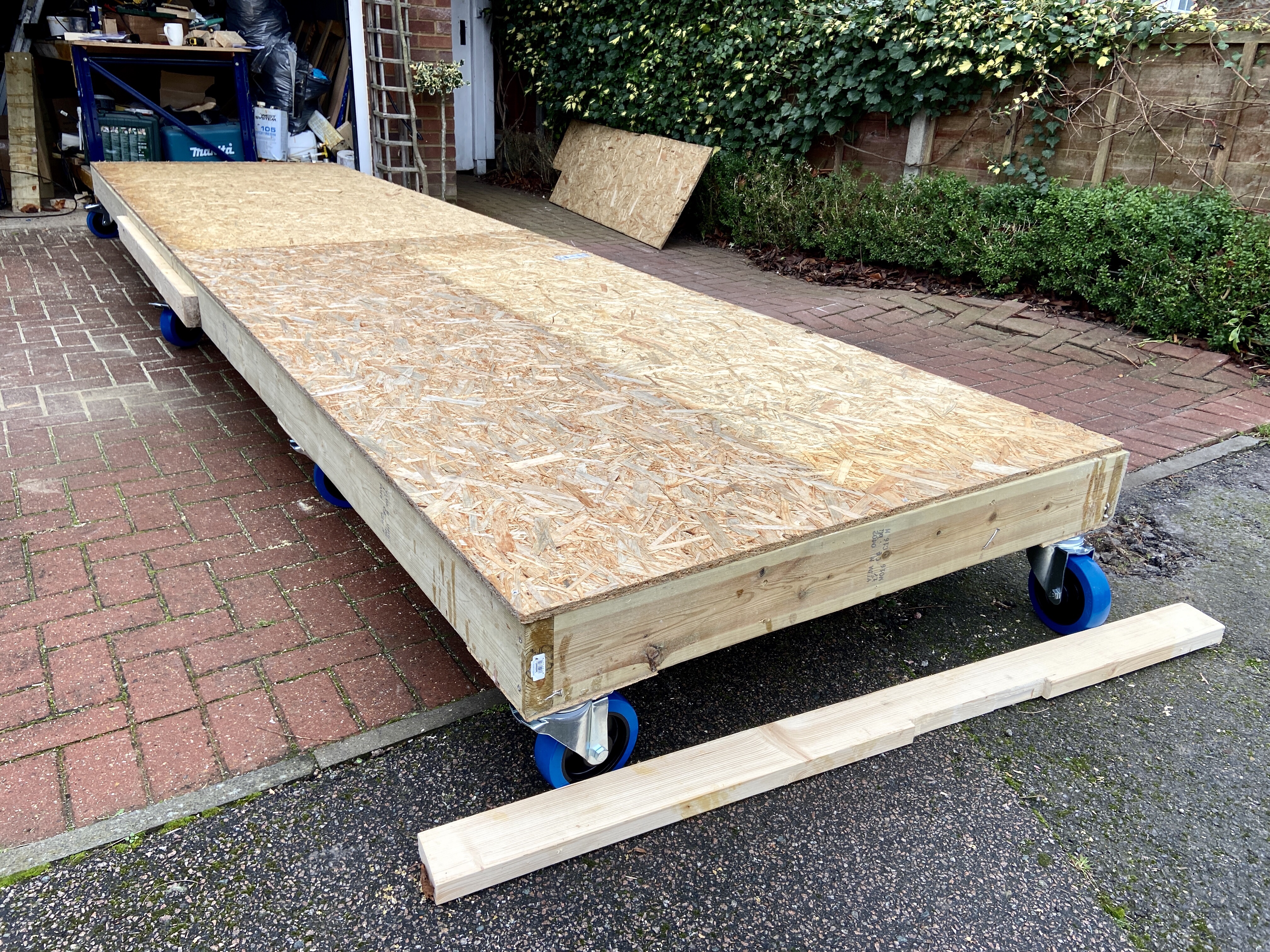
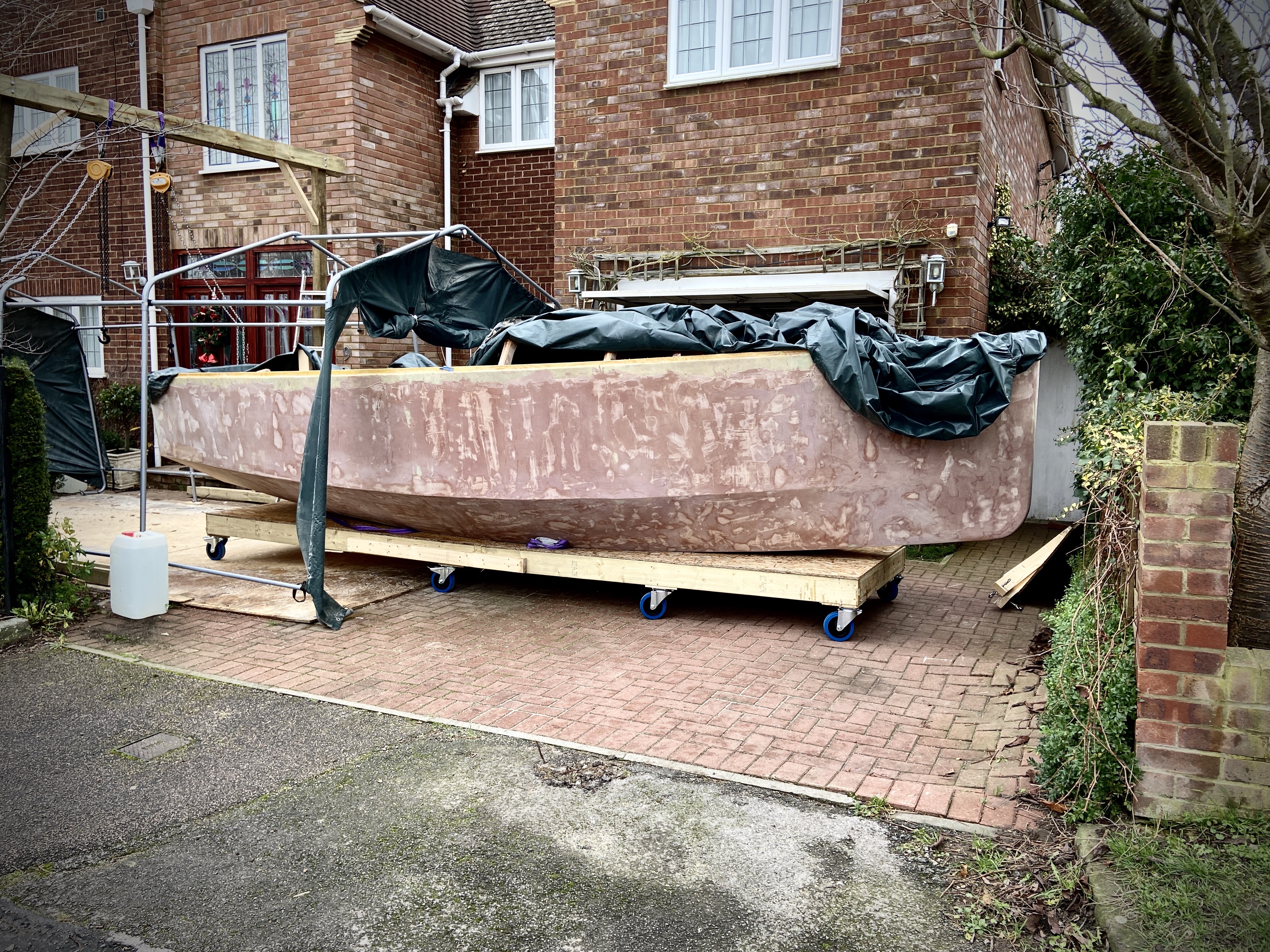
Putting the scaffold up was OK. But now do we get it down, when we no longer have a boat hull to stand on, and even try to stand on it now it is significantly lower than it was on the jig, and you can’t reach the load bearing beams over the hull. The last real challenge.
We solved this by fixing together a number of lifting strops to get two long lengths. We then looped one around each joint between the load bearing beam and the top of upright posts, either side of the hull. We unbolted and removed the lower coach bolt holding the upright….well upright. This then allowed us to do a controlled lowering of the uprights by pivoting the them and load bearing beams on the remaining coach bolt at the foot of the upright. Two of us controlling the lowering with the strops while two others walked the uprights down on their hands, until the load bearing beams came to rest on the upper side bars of the tent. Much more accessible than wafting around at the top of a ladder at 3.6m like Wylie Coyote trying to find a sky hook to carry a 3.6m long plank you have just unbolted!
So that was it- job done. As we were clearing up and reconstructing the tent the wind started to get up and we were being spotted with rain.
Two solid days. No way I could have done this without the family jumping in, helping and collaborating to solve the issues as they arose.
What would I have done differently? Not a lot, I think it all worked pretty well. But I think I would change a couple of things on the scaffold.
- I would change the 4’ by 2’ timber we used on the scaffold with 6’ by 2’. It worked fine but I think it would add another level of robustness
- We screwed the bracing arms onto the uprights and loading beams. I think if we could I would coach bolt them, again to add a little more robustness
- Perhaps find a way to hang the chain blocks from the top side of the loading beams rather than hanging under, maybe off a couple of metal bars secured across the top. But I didn’t have an bars lying around! However those extra 6 inches would have allowed the boat to swing easily through its arc without our manhandling.
I think that’s about all I would consider changing. It would have been easier if we didn’t have to put one of the uprights in the tent as it created a load of extra work, but that’s just the way it is.
We celebrated with some mulled wine to warm us up and our friend Captain Morgan came out to join us.
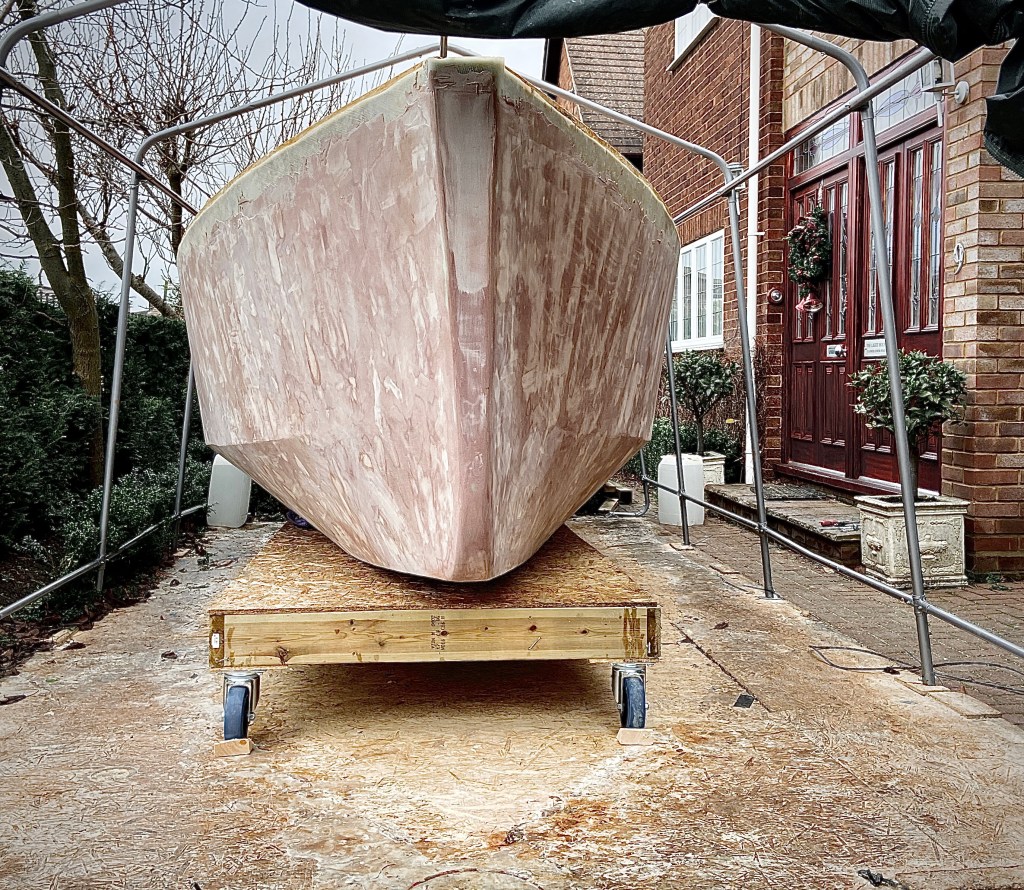
We now have a 580 hull on the drive. Complete with bright “go fast” blue wheels! After significant effort from the whole family its a great milestone and very satisfying. I think I’ll pop out and have a quick look!

 Pete's Class 5.80 Build Blog